asdex
Automatic Sparse Differentiation in JAX
29th EuroAD Workshop, Cambridge, UK
September 29th, 2026
September 29th, 2026
 SLIDES
Didn't you give this talk already?




How about JAX?

Why materialize Jacobians and Hessians?
- Newton-type solvers
- Implicit differentiation
- Laplace approximations
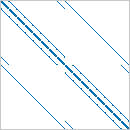
Brusselator PDE Jacobian on an 8×8 grid:
768 of 16384 entries nonzero
768 of 16384 entries nonzero
What is JAX?
“JAX is a Python library for accelerator-oriented array computation and program transformation,
designed for high-performance numerical computing and large-scale machine learning.”
import jax
import jax.numpy as jnp

def f(x):
    y = jnp.sin(x) ** 2
    return jnp.sum(y)

jax.grad(f)(x)
jax.vmap(jax.grad(f))(xs)
jax.jit(jax.vmap(jax.grad(f)))(xs)

JAX's IR: jaxpr
def f(x):
    y = jnp.sin(x)
    y = y ** 2
    return y
$f(\vx) = \sin(\vx)^2\ \rightarrow$
jax.make_jaxpr(f)(x)
{ lambda ; a:f32[5]. let
    b:f32[5] = sin a
    c:f32[5] = integer_pow[y=2] b
  in (c,) }
- explicitly typed
- functional
- first-order
- A-normal form
jax.jvp
jax.vmap
{ lambda ; a:f32[5] b:f32[5]. let
    c:f32[5] = sin a
    d:f32[5] = cos a
    e:f32[5] = mul b d
    f:f32[5] = integer_pow[y=2] c
    g:f32[5] = mul 2.0:f32[] c
    h:f32[5] = mul e g
  in (f, h) }
$\vx,\ \vv\ \rightarrow$
$f(\vx)\ \leftarrow$
$Df(\vx)(\vv)\ \leftarrow$
{ lambda ; a:f32[3,5]. let
    b:f32[3,5] = sin a
    c:f32[3,5] = integer_pow[y=2] b
  in (c,) }
Transformations compose
jax.jvp
partial eval
jax.linearize
transpose
jax.vjp
seed 1.0
jax.grad
$(\vx, \vv) \mapsto$$(f(\vx),\ Df(\vx)(\vv))$
$\vx \mapsto$$(f(\vx),\ \vv \mapsto Df(\vx)(\vv))$
$\vx \mapsto$$(f(\vx),\ \vw \mapsto Df(\vx)^*(\vw))$
$\vx \mapsto$$Df(\vx)^*(1)$
vmap
jax.jacfwd
$\vx \mapsto \Jf\big|_{\vx}$
vmap
jax.jacrev= jax.jacobian$\vx \mapsto \Jf\big|_{\vx}$

asdex
Jacobian sparsity pattern detection demo
import asdex
import jax.numpy as jnp

def f(x):
    y = jnp.sin(x) ** 2
    return y[1:] - y[:-1]

x = jnp.arange(5.0)
print(asdex.jacobian_sparsity(f, x))
SparsityPattern(4×5, nnz=8, sparsity=60.0%)
● ● ⋅ ⋅ ⋅
⋅ ● ● ⋅ ⋅
⋅ ⋅ ● ● ⋅
⋅ ⋅ ⋅ ● ●
Hessian sparsity pattern detection
def hessian_sparsity(f, x):
    grad_f = jax.grad(f)
    return jacobian_sparsity(grad_f, x)
For free!
Preparation mechanism
JAX
make_jaxpr(jax.jacfwd(f))(x)
{ lambda ; a:f32[1000]. let
    b:i32[1000,1000] = iota[dimension=0]
    c:i32[1000,1000] = iota[dimension=1]
    d:i32[1000,1000] = add b 0:i32[]
    e:bool[1000,1000] = eq d c
    f:f32[1000,1000] = convert_element_type e
    g:f32[1000,1000] = split f
    h:f32[1000] = sin a
    i:f32[1000] = cos a
    j:f32[1,1000] = broadcast_in_dim i
    k:f32[1000,1000] = mul g j
    l:f32[1000] = integer_pow[y=2] h
    m:f32[1000] = mul 2.0:f32[] h
    n:f32[1,1000] = broadcast_in_dim m
    o:f32[1000,1000] = mul k n
    p:f32[999] = slice[1:1000] l
    q:f32[1000,999] = slice[:,1:1000] o
    r:f32[999] = slice[0:999] l
    s:f32[1000,999] = slice[:,0:999] o
    _:f32[999] = sub p r
    t:f32[1000,999] = sub q s
    u:f32[999,1000] = transpose t
    v:f32[999,1000] = split u
  in (v,) }
asdex
make_jaxpr(asdex.jacobian(f, x))(x)
{ lambda a:f32[2,1000] b:i32[1998,2]
         c:i32[1998,2]; d:f32[1000]. let
    e:f32[1000] = sin d
    f:f32[1000] = cos d
    g:f32[1000] = integer_pow[y=2] e
    h:f32[1000] = mul 2.0:f32[] e
    i:f32[999] = slice[1:1000] g
    j:f32[999] = slice[0:999] g
    _:f32[999] = sub i j
    k:f32[1,1000] = broadcast_in_dim f
    l:f32[2,1000] = mul a k
    m:f32[1,1000] = broadcast_in_dim h
    n:f32[2,1000] = mul l m
    o:f32[2,999] = slice[:,1:1000] n
    p:f32[2,999] = slice[:,0:999] n
    q:f32[2,999] = sub o p
    r:f32[1998] = gather q b
  in (r, c) }
- Detect + color: slow, once, as in DI.jl [DH26]
- Seeds $\mS$ are constants
- One primal pass, shared by all JVPs
- JVPs batched over 2 colors, not 1000
Just a jaxpr: composes with
jit, vmap, gradPytree inputs and outputs
def f(x):
    u, p = x["u"], x["p"]
    return {"a": p[0] * u + p[1], "b": jnp.diff(u)}

x = {"u": jnp.array([1.0, 2.0, 3.0]), "p": jnp.array([2.0, 5.0])}
jax.jacobian(f)(x)
{'a': {'p': Array([[1., 1.],
                   [2., 1.],
                   [3., 1.]], dtype=float32),
       'u': Array([[2., 0., 0.],
                   [0., 2., 0.],
                   [0., 0., 2.]], dtype=float32)},
 'b': {'p': Array([[0., 0.],
                   [0., 0.]], dtype=float32),
       'u': Array([[-1.,  1.,  0.],
                   [ 0., -1.,  1.]], dtype=float32)}}
asdex.jacobian(f, x)(x)
{'a': {'p': BCOO(float32[3, 2], nse=6),
       'u': BCOO(float32[3, 3], nse=3)},
 'b': {'p': BCOO(float32[2, 2], nse=0),
       'u': BCOO(float32[2, 3], nse=4)}}
Other features
- Automatic mode: JVPs or VJPs, whichever needs fewer colors
- Symmetric (star) coloring for Hessians [Geb+07]
- HVPs as fwd-over-rev, rev-over-fwd or rev-over-rev
- Control flow:
cond,scan,while_loop chunk_sizebounds the memory of the batched AD passes
argnums,has_aux,value_and_jacobian- User-provided sparsity patterns
- Save and load colorings
- Output formats: BCOO, dense, NumPy, SciPy
- Verification against vanilla JAX
spyplots of patterns
About robotshumans
- Tests based on the thorough test suites of SparseConnectivityTracer.jl [HD25] and SparseMatrixColorings.jl [MDG25]
- Round-trip tests against vanilla JAX: rapid development of sparsity detection
- Guillaume Dalle reviewed and maintains the coloring code
- Preprint coming soon


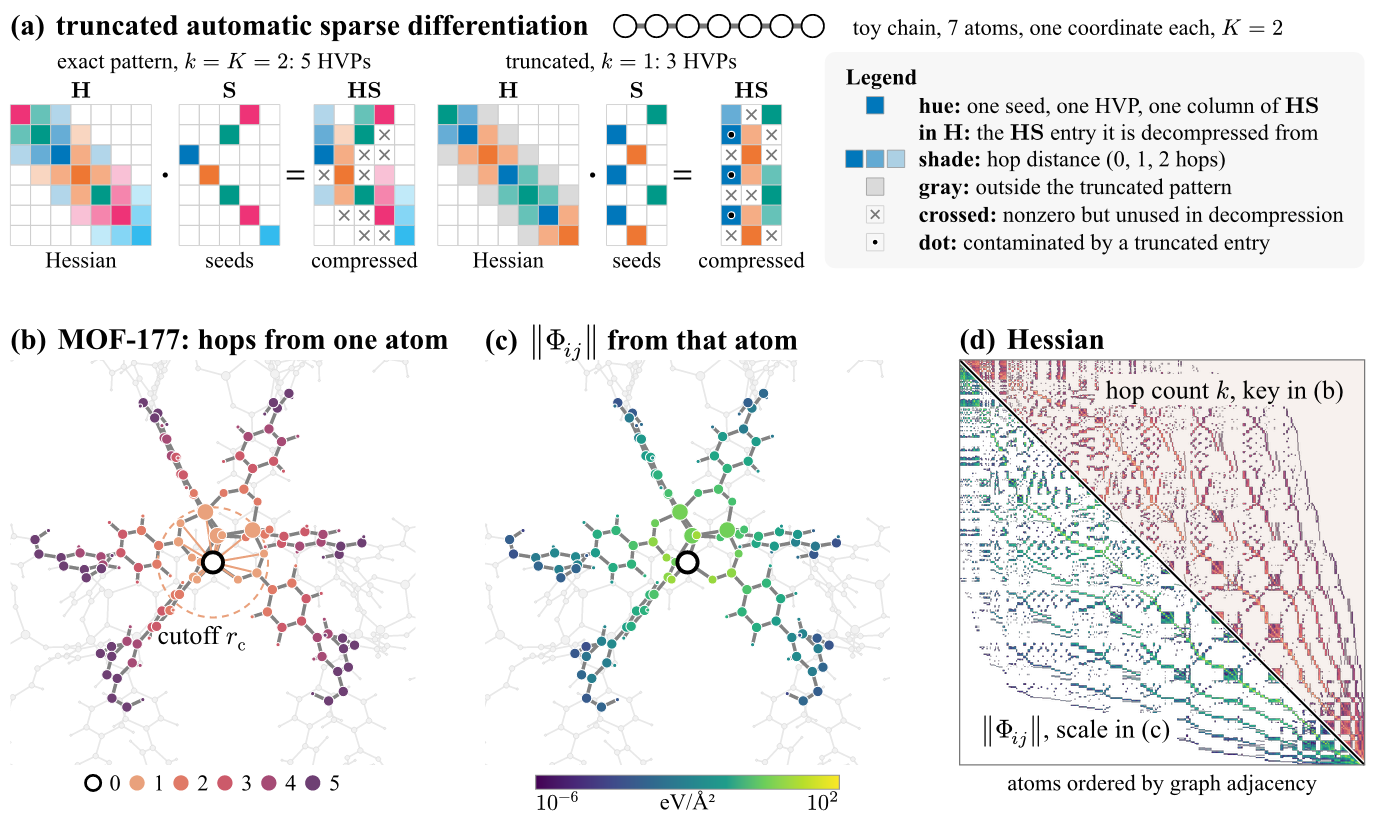
Applications: truncated sparse AD
Bibliography
[Bis+96]C. H. Bischof, P. M. Khademi, A. Bouaricha, and A. Carle, “Efficient Computation of Gradients and Jacobians by Dynamic Exploitation of Sparsity in Automatic Differentiation,” Optimization Methods and Software, vol. 7, no. 1, pp. 1–39, Jan. 1996, doi: 10.1080/10556789608805642.
[CM83]T. F. Coleman and J. J. Moré, “Estimation of Sparse Jacobian Matrices and Graph Coloring Problems,” SIAM Journal on Numerical Analysis, vol. 20, no. 1, pp. 187–209, 1983, doi: 10.1137/0720013.
[CPR74]A. R. Curtis, M. J. D. Powell, and J. K. Reid, “On the Estimation of Sparse Jacobian Matrices,” IMA Journal of Applied Mathematics, vol. 13, no. 1, pp. 117–119, Feb. 1974, doi: 10.1093/imamat/13.1.117.
[DH26]G. Dalle and A. Hill, “A Common Interface for Automatic Differentiation,” Journal of Machine Learning Research, vol. 27, pp. 25:1–25:13, 2026, https://jmlr.org/papers/v27/25-1024.html
[DMM90]L. C. W. Dixon, Z. Maany, and M. Mohseninia, “Automatic Differentiation of Large Sparse Systems,” Journal of Economic Dynamics and Control, vol. 14, no. 2, pp. 299–311, May 1990, doi: 10.1016/0165-1889(90)90023-a.
[Geb+07]A. H. Gebremedhin, A. Tarafdar, F. Manne, and A. Pothen, “New Acyclic and Star Coloring Algorithms with Application to Computing Hessians,” SIAM Journal on Scientific Computing, vol. 29, no. 3, pp. 1042–1072, 2007, doi: 10.1137/050639879.
[GK06]R. Giering and T. Kaminski, “Automatic Sparsity Detection Implemented as a Source-to-Source Transformation,” in Computational Science – ICCS 2006, LNCS, vol. 3994, Springer, 2006, pp. 591–598, doi: 10.1007/11758549_81.
[GMP05]A. H. Gebremedhin, F. Manne, and A. Pothen, “What Color Is Your Jacobian? Graph Coloring for Computing Derivatives,” SIAM Review, vol. 47, no. 4, pp. 629–705, 2005, doi: 10.1137/s0036144504444711.
[GUG96]U. Geitner, J. Utke, and A. Griewank, “Automatic Computation of Sparse Jacobians by Applying the Method of Newsam and Ramsdell,” in Computational Differentiation: Techniques, Applications, and Tools, Philadelphia, PA: SIAM, 1996, pp. 161–172.
Bibliography
[GW08]A. Griewank and A. Walther, Evaluating Derivatives: Principles and Techniques of Algorithmic Differentiation, 2nd ed. Philadelphia, PA: SIAM, 2008, doi: 10.1137/1.9780898717761.
[HD25]A. Hill and G. Dalle, “Sparser, Better, Faster, Stronger: Sparsity Detection for Efficient Automatic Differentiation,” Transactions on Machine Learning Research, Jun. 2025, https://openreview.net/forum?id=GtXSN52nIW
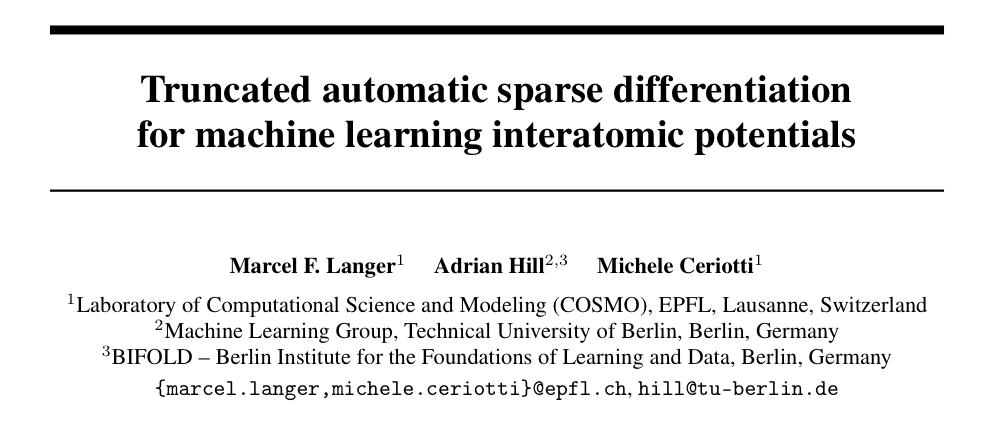
[LHC26]M. F. Langer, A. Hill, and M. Ceriotti, “Truncated automatic sparse differentiation for machine learning interatomic potentials,” arXiv:2609.20510, 2026. https://arxiv.org/abs/2609.20510
[MDG25]A. Montoison, G. Dalle, and A. H. Gebremedhin, “Revisiting Sparse Matrix Coloring and Bicoloring,” arXiv:2505.07308, 2025. https://arxiv.org/abs/2505.07308