Many tasks in scientific computing and machine learning require the Jacobian or Hessian matrix of a function. Automatic differentiation (AD) computes these derivatives to machine precision, but materializing a dense m × n Jacobian requires n forward-mode or m reverse-mode AD passes, one per column or row. For a large class of functions, each output depends on only a few inputs, making the derivative matrix sparse. Automatic sparse differentiation (ASD) exploits this structure in four steps: detection of the input-agnostic sparsity pattern, coloring of a graph to group columns or rows that can share an AD pass, compressed differentiation to compute a compressed derivative matrix with one AD pass per color, and finally decompression into the original sparsity pattern. The number of colors, and hence of AD passes, is often independent of the problem dimension: a banded Jacobian with b contiguous bands, for instance, only ever requires b colors, regardless of its size. asdex offers the first standalone ASD toolkit in the popular JAX ecosystem. With asdex.jacobian and asdex.hessian, it provides sparse drop-in replacements for jax.jacobian and jax.hessian.
Peer-reviewed publications, awards, talks, and courses I've taught.
Publications
Machine learning interatomic potentials (MLIPs) learn the mapping from atomic positions to potential energy. The forces, the negative gradient of this energy, drive molecular dynamics and are readily obtained using automatic differentiation. Higher-order derivatives, most notably the Hessian, describe collective motion and allow the direct prediction of experimental observables, but are considered computationally inaccessible for large systems. We suggest a solution: in physical systems, interactions decay with distance, and most MLIPs build on this locality through message passing up to a finite receptive field. This implies both sparsity of higher-order derivatives and their decay with distance. This structure can be exploited using automatic sparse differentiation (ASD). We explain how to compute the sparsity pattern for MLIP derivatives and demonstrate that, for multiple foundation MLIPs, ASD computes full Hessians of large porous materials exactly, but with modest speedups at best. The larger gains come from truncated ASD: discarding small, but nonzero, Hessian entries between distant atoms yields order-of-magnitude speedups with negligible impact on predicted observables.
For scientific machine learning tasks with a lot of custom code, picking the right Automatic Differentiation (AD) system matters. Our Julia package DifferentiationInterface.jl provides a common frontend to a dozen AD backends, unlocking easy comparison and modular development. In particular, its built-in preparation mechanism leverages the strengths of each backend by amortizing one-time computations. This is key to enabling sophisticated features like sparsity handling without putting additional burdens on the user.
Explaining complex machine learning models is a fundamental challenge when developing safe and trustworthy deep learning applications. To date, a broad selection of explainable AI (XAI) algorithms exist. One popular choice is SmoothGrad, which has been conceived to alleviate the well-known shattered gradient problem by smoothing gradients through convolution. SmoothGrad proposes to solve this high-dimensional convolution integral by sampling — typically approximating the convolution with limited precision. Higher numbers of samples would amount to higher precision in approximating the convolution but also to higher computing demand, therefore in practice only few samples are used in SmoothGrad. In this work we propose a well founded novel method SmoothDiff to resolve this tradeoff yielding a speedup of over two orders of magnitude. Specifically, SmoothDiff leverages automatic differentiation to decompose the expected values of Jacobians across a network architecture, directly targeting only the non-linearities responsible for shattered gradients and making it easy to implement. We demonstrate SmoothDiff's excellent speed and performance in a number of experiments and benchmarks. Thus, SmoothDiff greatly enhances the usability (quality and speed) of SmoothGrad — a popular workhorse of XAI.
From implicit differentiation to probabilistic modeling, Jacobian and Hessian matrices have many potential use cases in Machine Learning (ML), but they are viewed as computationally prohibitive. Fortunately, these matrices often exhibit sparsity, which can be leveraged to speed up the process of Automatic Differentiation (AD). This paper presents advances in sparsity detection, previously the performance bottleneck of Automatic Sparse Differentiation (ASD). Our implementation of sparsity detection is based on operator overloading, able to detect both local and global sparsity patterns, and supports flexible index set representations. It is fully automatic and requires no modification of user code, making it compatible with existing ML codebases. Most importantly, it is highly performant, unlocking Jacobians and Hessians at scales where they were considered too expensive to compute. On real-world problems from scientific ML, graph neural networks and optimization, we show significant speed-ups of up to three orders of magnitude. Notably, using our sparsity detection system, ASD outperforms standard AD for one-off computations, without amortization of either sparsity detection or matrix coloring.
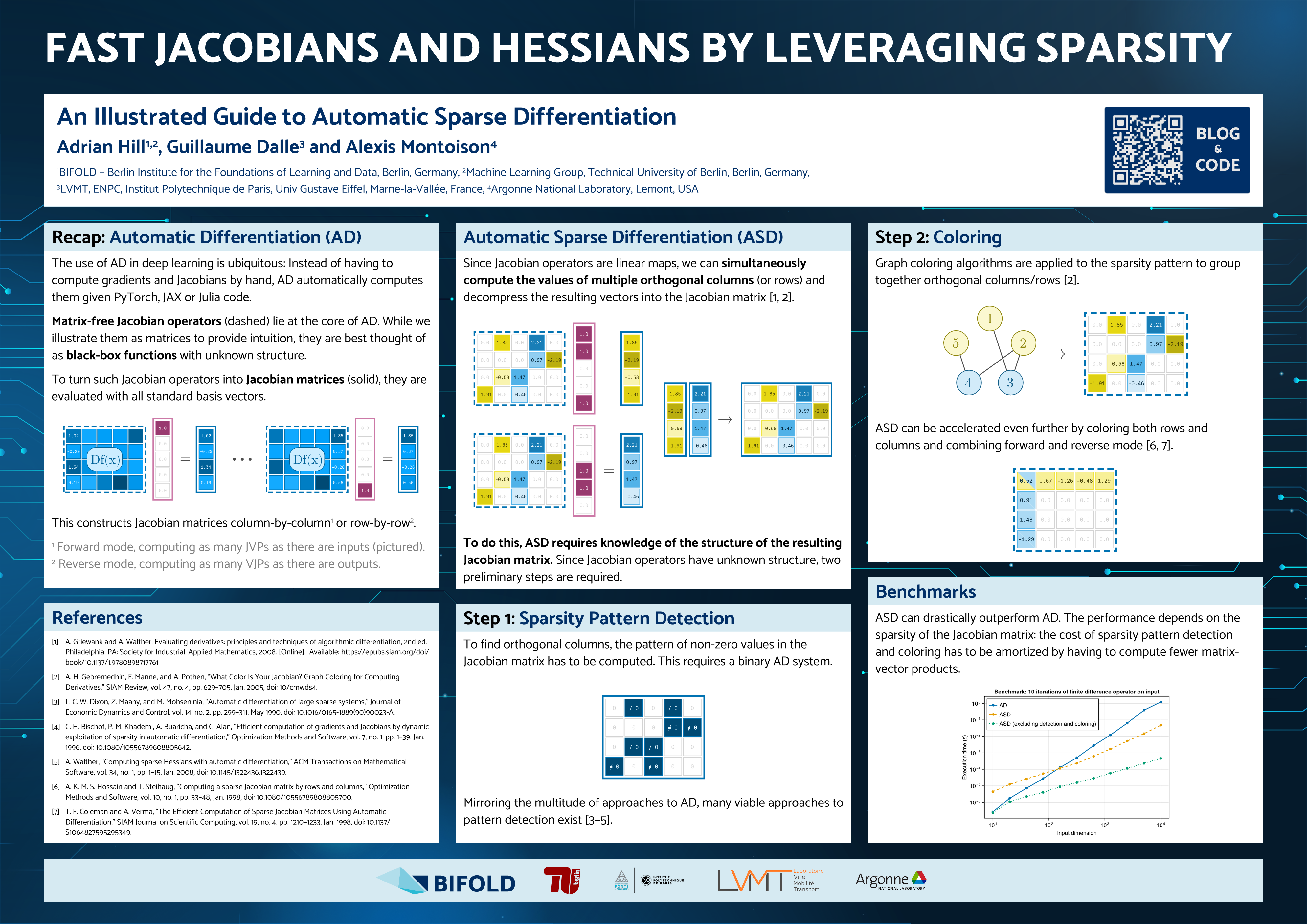
In numerous applications of machine learning, Hessians and Jacobians exhibit sparsity, a property that can be leveraged to vastly accelerate their computation. While the usage of automatic differentiation in machine learning is ubiquitous, automatic sparse differentiation (ASD) remains largely unknown. This post introduces ASD, explaining its key components and their roles in the computation of both sparse Jacobians and Hessians. We conclude with a practical demonstration showcasing the performance benefits of ASD.
Awards
Prix science ouverte du logiciel libre de recherche: Open source software award for DifferentiationInterface.jl (G. Dalle, A. Hill), awarded by the French Ministry of Higher Education and Research
Talks
JAX is increasingly popular in scientific computing, yet its API for materializing Jacobian and Hessian matrices is strictly dense, with jax.jacfwd, jax.jacrev, and jax.hessian all performing one AD pass per input or output dimension. For the large sparse systems that arise in nonlinear solvers and second-order optimization, this is prohibitive in both memory and compute. Sparse automatic differentiation (i.e., compressed evaluation) avoids both bottlenecks by exploiting the sparsity of the derivative matrices, but no general-purpose implementation exists for JAX. We present asdex, an open-source package that fills this gap with sparse drop-in replacements for JAX's Jacobian and Hessian functions. asdex detects Jacobian sparsity patterns by abstract interpretation of jaxprs, JAX's functional intermediate representation. Propagating index sets through the program yields conservative global patterns without modifying user code. Since jax.grad is a function transformation producing an ordinary jaxpr, detecting the Jacobian sparsity of the gradient yields Hessian sparsity patterns for free. Greedy distance-2 and star coloring algorithms then group structurally orthogonal columns or rows of the detected pattern, so that one batched JVP or VJP per group recovers every nonzero. Following the design of DifferentiationInterface.jl in Julia, asdex separates one-time preparation from repeated evaluation, amortizing the cost of sparsity detection and coloring. Prepared derivative functions are plain JAX functions that compose with jax.jit and jax.vmap and run on CPU, GPU, and TPU.
Jacobians and Hessians play vital roles in scientific computing and machine learning, from optimization to probabilistic modeling. While these matrices are often considered too computationally expensive to calculate, their inherent sparsity can be leveraged to dramatically accelerate Automatic Differentiation (AD). By building on top of DifferentiationInterface.jl, we are able to bring Automatic Sparse Differentiation to all major Julia AD backends, including ForwardDiff and Enzyme.
Despite AD's widespread adoption in the Julia ecosystem, Automatic Sparse Differentiation (ASD) remains an underutilized technique. We present a novel pipeline consisting of three open-source packages to bring ASD capabilities to all major Julia AD backends. The first half of the talk focuses on the unique challenges AD users face in Julia, introducing DifferentiationInterface.jl, a unified interface for over a dozen AD backends. The second half focuses on sparsity pattern detection, a key component of ASD. We present SparseConnectivityTracer.jl (SCT), a performant implementation of Jacobian and Hessian sparsity detection based on operator-overloading. SCT computes both local and global sparsity patterns, naturally avoids dead-ends in compute graphs and requires no code modifications. Notably, our ASD pipeline often outperforms standard AD for one-off computations, previously thought impractical in Julia due to slower sparsity detection methods.
Automatic Differentiation (AD) is the art of letting your computer work out derivatives for you. The Julia ecosystem provides many different AD tools, which can be overwhelming. This talk will give everyone the necessary information to answer two simple questions: As a developer, how do I make my functions differentiable? As a user, how do I differentiate through other people's functions?
ExplainableAI.jl, a comprehensive set of XAI tools for Julia, has undergone significant development since our initial presentation at JuliaCon 2022, and has since been expanded into the Julia-XAI ecosystem. This lightning talk will highlight the latest developments, including new methods, the new XAIBase.jl core interface, and new utilities for visualizing explanations of vision and language models.
In pursuit of interpreting black-box models such as deep image classifiers, a number of techniques have been developed that attribute and visualize the importance of input features with respect to the output of a model. ExplainableAI.jl brings several of these methods to Julia, building on top of primitives from the Flux ecosystem. In this talk, we will give an overview of current features and show how the package can easily be extended, allowing users to implement their own methods and rules.
Dithering algorithms are a group of color quantization techniques that create the illusion of continuous color in images with small color palettes by adding high-frequency noise or patterns. Traditionally used in printing, they are now mostly used for stylistic purposes. DitherPunk.jl implements a wide variety of fast and extensible dithering algorithms. Using its example, I will demonstrate how packages for creative coding can be built on top of the JuliaImages ecosystem.
Teaching
- 2023–2026: Julia for Machine Learning
- 2023–2026: Deep Learning 2: Neural ODE lecture
- 2022–2023: Project Machine Learning